Why One minute website visits are often the ultimate metric for your business
If you’re a business owner, you’ve likely checked your Google Analytics and wondered if short visits are a bad sign. You might see website visitors spending a minute or less on your site and worry that it is not performing well. It is a common concern, and it often stems from outdated advice that more time on site equals more interest.
The reality is that in today’s digital environment, every business is competing for a website visitor’s limited attention. People are constantly pulled in different directions by alerts, emails, and competing tasks. Visitors have become experts at scanning, evaluating, and deciding if you are worth their time.
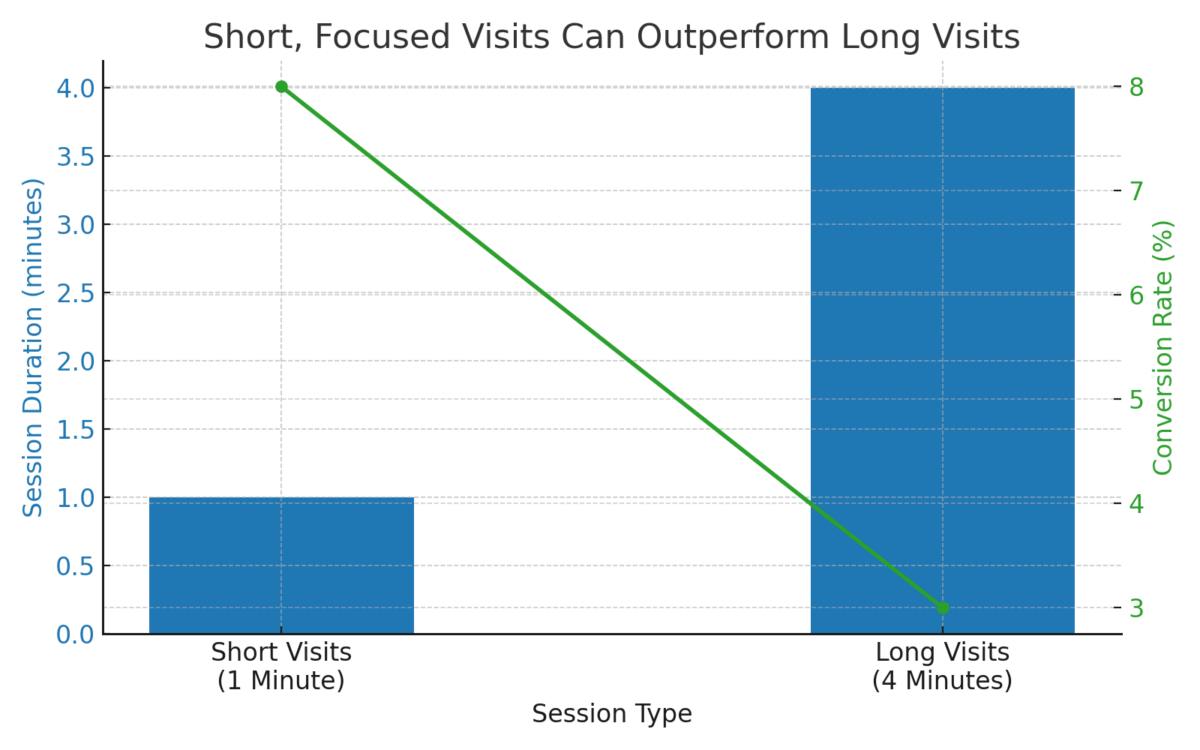
A focused one-minute visit that results in a conversion is not a problem. It is a sign of an efficient website that is providing a clear, frictionless user experience. Your goal is not to entertain visitors for as long as possible. Your goal is to help them take the next step with confidence and minimal effort.
Short Sessions Can Signal Strong Performance

A short session often signals that your website is doing exactly what it should. When a website visitor’s goal is met quickly and efficiently, they do not need to spend extra time. This is especially true for service-based businesses and local companies where customers often visit the site to complete a single, specific action.
A well-designed website anticipates user needs. It has clear navigation, prominent calls-to-action (CTAs), and easily scannable content that guides visitors directly to their objective. This approach respects their time and energy. Instead of holding their attention with unnecessary information, your site should guide them toward making a decision.
If your analytics show a high conversion rate paired with short session durations, you are not failing. You are succeeding in delivering what people want without making them work for it.
Example:
A local plumber noticed their average website session was just 45 seconds. Rather than panic, they looked deeper into the data. Those quick visits often resulted in phone calls from customers with urgent needs. The site made it easy to find the emergency number, and that was exactly what mattered. Those fast interactions brought in real revenue.
Zero-Click Search and the new SEO

The way people use search engines has changed significantly. Search results now often provide direct answers to common questions without requiring a click to any website. This is called a zero-click search, and it means your website visitors arrive with more information and clearer intent than ever before.
When someone does click through to your site, they are not browsing casually. They have already seen a snippet of your content in the search results. They are coming to confirm details, see expert guidance, or take direct action.
Your website’s role is no longer to walk them through the basics. Instead, it should confirm you are the right choice and make it effortless to move forward.
Example:
A small business owner searching for “how to file LLC taxes” found a brief step-by-step summary at the top of the search results. The overview was helpful but incomplete. Feeling overwhelmed, she clicked on a local accounting firm’s site to see if they worked with small businesses. She quickly found their services and pricing pages, then filled out a contact form to request a quote. That short visit became a high-quality lead from a visitor who had already done her initial research.
Longer Visits Are Not Always Better

It is tempting to think that a long visit means strong engagement, but that is not always true. A prolonged session can sometimes reveal problems with usability or clarity.
If a website visitor spends several minutes on your site without taking action, they may be lost, frustrated, or unsure how to proceed. They could be trying to locate simple information that is buried, or they might be confused by your navigation and content structure. This is not a sign of deep interest. It is a sign that the experience is harder than it should be.
Example:
A shopper looking for a specific pair of sneakers visited an e-commerce site and spent over four minutes trying to locate the product. The search and filtering options were confusing, and the navigation was unclear. When the shoes were finally found, the checkout process was complicated and revealed unexpected fees. The visitor abandoned the cart. While the session length looked positive, it reflected a poor user experience that cost the business a sale.
The Reality of Modern Web Browsing

You have likely heard the claim that humans now have a shorter attention span than a goldfish. While the statistic itself is more of a cliche than a precise measurement, it still illustrates an important point: modern consumers have limited time and attention than ever before.
Your website is not only competing with other businesses in your industry. It is competing with the noise and activity of your website visitor’s day. This means your site must prove its value almost instantly. If a visitor can land on your page, scan your content, and decide to contact you in less than a minute, that is a success. You have cut through distractions, provided clarity, and prompted action before their attention shifted to something else.
Local businesses that perform well online are not the ones that hold visitors the longest. They are the ones that deliver the right message at the exact right time. Sometimes, that window of opportunity lasts 60 seconds or less.
Example:
A busy mom working from home clicked on a local electrician’s website while juggling a client call, answering team messages, and keeping an eye on her toddler. With only a brief moment of focus, she scanned the homepage, spotted a clear list of services, read a short customer review, and tapped the “Request a Service” button. The visit lasted less than a minute, but it resulted in a booked service. The site succeeded because it delivered the right information at the right time, cutting through a day full of distractions.
How to Design for the One-Minute Conversion
If short visits can lead to high-value outcomes, your website should be built to maximize that opportunity. Here are strategies to ensure quick visits convert into business:
1. Lead with Clarity
Your headline should immediately communicate what you do, who you serve, and what the next step is. Avoid vague or overly clever language that forces the visitor to figure it out.
2. Prioritize Calls-to-Action
Your primary action — whether it is calling, booking, or requesting a quote — should be visible without scrolling. Use clear, action-oriented text and make sure the button or link stands out.
3. Simplify Navigation
Too many options slow people down. Limit menu items to the essentials, and make the path to your main conversion points obvious.
4. Optimize for Mobile
Most visitors will view your site on a phone. Test it on different devices to ensure forms, buttons, and text are easy to use.
5. Show Trust Quickly
Display testimonials, reviews, certifications, and relevant credentials where they can be seen right away. A visitor’s confidence often determines whether they act.
6. Anticipate Questions
If there are common questions or objections in your sales process, address them directly on your key pages. This can shorten decision time and reduce hesitation.
Measuring the Right Success Indicators
When reviewing your analytics, do not focus solely on session duration. Instead, track metrics that reveal the real impact of your website:
Conversion rate: Percentage of visitors who take your desired action.
Goal completions: Number of forms filled, calls made, or purchases completed.
Bounce rate with context: High bounce rates without conversions can indicate issues, but short sessions with conversions are healthy.
Return visits: Repeat visitors often signal trust and interest.
A shorter average session that consistently drives conversions is a sign your website is working efficiently.
A Fresh Perspective on Short Visits
For successful online experiences, speed and clarity win. A website visitor who finds what they need and acts quickly is demonstrating trust in your business. They are also rewarding you for respecting their time.
If your analytics show that many of your visitors complete their goals in a minute or less, that is not a weakness. It is a strength that you can build on. By focusing on a streamlined, user-friendly experience, you create a website that turns interest into action with minimal friction.
The Takeaway
A one-minute visit can be the most valuable moment you get with a potential customer. When your website is clear, easy to navigate, and built for action, that minute is all you need to convert curiosity into commitment.
Instead of chasing longer session durations, measure your success by the number of people who arrive with intent and leave having taken the next step. That is the metric that matters.
If you want to make every second count, review your site through the lens of clarity, trust, and ease of action. The businesses that succeed online are not those that keep visitors the longest. They are the ones that turn minutes into measurable results.