Discover why the Old SEO Playbook is Dying and How to Dominate Zero-Click Searches
Remember when the goal of SEO was simple? Get to the number one spot on Google, collect the click, and convert the user on your website. For years, that was the game. But as we navigate 2025, the game has fundamentally changed. The single most significant shift isn’t a new algorithm, but a new user behavior, actively encouraged by Google itself: the zero-click search.
If you’ve noticed your traffic plateauing or even dipping despite strong rankings, you’re not alone. You’re witnessing the new reality of SEO. A zero-click search is one where the user’s query is answered directly on the search engine results page (SERP), making a click to a third-party website unnecessary.
This isn’t the death of SEO altogether. It’s the evolution. And understanding how to navigate this new landscape is the key to digital marketing success in 2025 and beyond.
Zero-click Search at a glance
What is a Zero-Click Search?
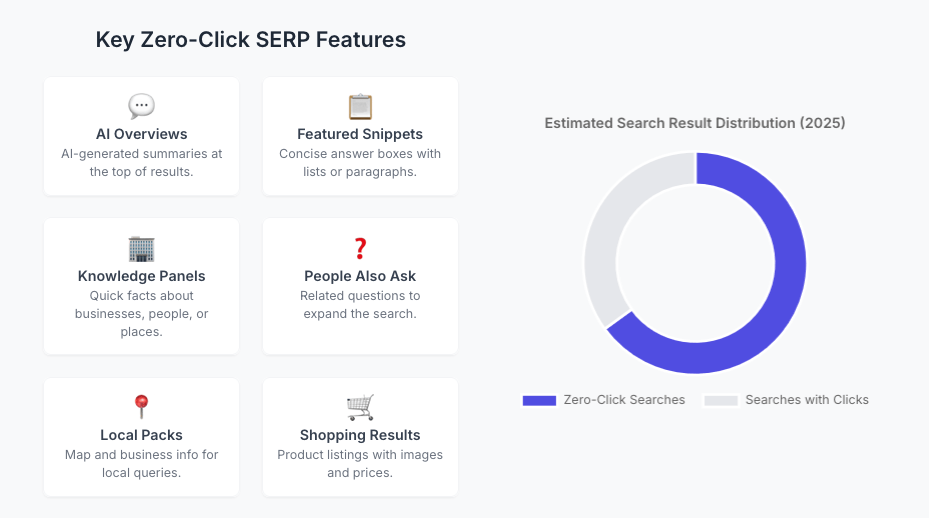
A “zero-click search” occurs when a user’s question is answered directly on the Google Search Results Page (SERP), eliminating the need to click on any website link. This shift is driven by Google’s goal to provide the most efficient path to information, powered by advancements in AI and a mobile-first approach. This chart explores the key features behind the trend and its significance on organic traffic.
The Challenge: Losing Direct Website Visits
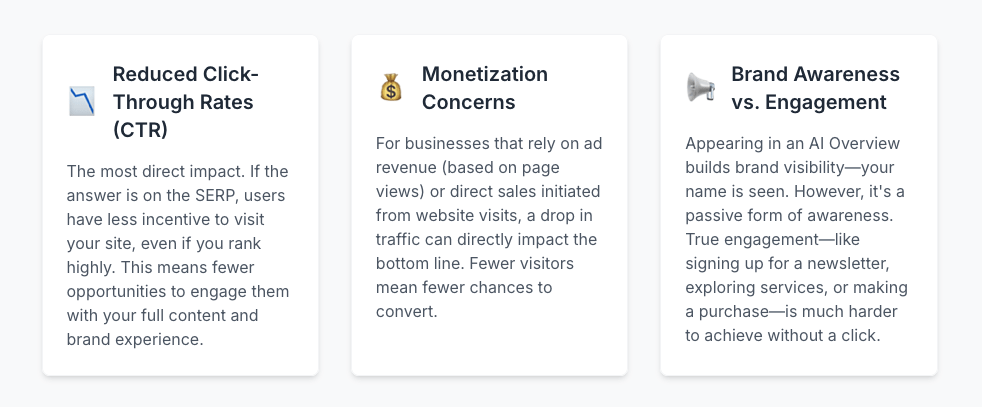
While gaining visibility on the search results page is valuable, the rise of zero-click searches presents significant challenges for website owners. When users get their answers without clicking, it directly impacts key metrics and business goals that have traditionally relied on organic traffic. Understanding these challenges is the first step toward building an effective strategy to counteract them.
Actionable Strategies for a Zero-Click World
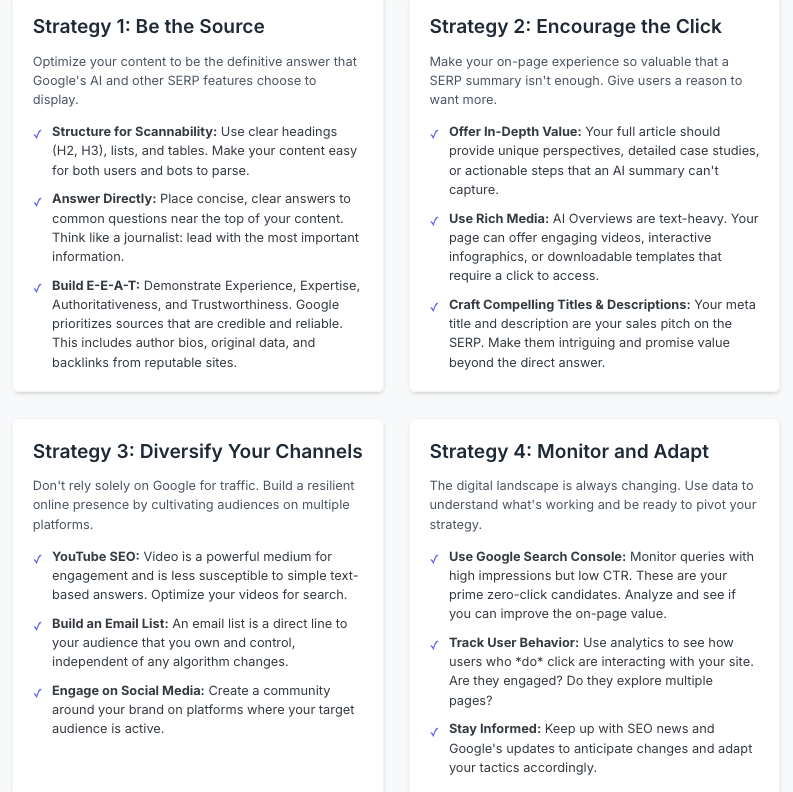
Adapting to the zero-click landscape isn’t about fighting Google; it’s about evolving your strategy. The goal is twofold: become the authoritative source Google trusts for its direct answers, and provide such compelling value that users are encouraged to click through for more. This requires a multi-faceted approach focusing on content optimization, user experience, and strategic diversification.

What's Driving the shift to Zero-Click?
The rise of zero-click searches is a direct result of Google’s mission to provide the most direct and fastest answer possible. This is accomplished through a growing number of rich SERP features.
The primary driver in 2025 is, without a doubt, Google’s AI Overviews. These AI-powered summaries sit at the very top of the SERP, synthesizing information from multiple websites to provide a comprehensive, direct answer to complex questions.
Other key contributors include:
- Featured Snippets: The original "position zero," providing a direct answer in a box.
- Knowledge Panels: Cards that appear for entities like people, places, and brands.
- People Also Ask (PAA) Boxes: Accordion-style dropdowns of related questions.
- Local Packs: The map and three business listings for "near me" searches.
- Calculators, definitions, and currency converters : Quick, immediate reference tools.
Voice Search and the Rise of Zero-Click Searches
Voice search is transforming how people access information online. Today, over 1 billion people worldwide, which is about 20–21% of internet users, use voice assistants like Siri and Google Assistant every month. In the United States alone, nearly half the population engages with voice technology, with 27% using voice search specifically on mobile devices. Young adults are leading this shift, relying on voice commands for everything from checking the weather to finding the nearest coffee shop.
According to recent data, nearly 60% of Google searches now end without a website visit1. Voice search plays a major role, as spoken queries often prompt direct answers read aloud from featured snippets or knowledge panels.
Examples of voice search behavior that impact web traffic:
Conversational Queries: Users phrase questions naturally, like “What time does Starbucks open?” Google responds with a concise answer, often without showing a list of websites.
Featured Snippets and Answer Boxes: Voice assistants pull responses from highlighted information, delivering instant answers.
Local Intent: Voice searches are three times more likely to be local. Questions such as “Where’s the nearest hardware store?” get resolved instantly, often with a map or directions.
Single-Response Model: Voice assistants typically give just one answer, making it less likely users will browse multiple results.
The Dilemma: Is Zero-Click a Threat or an Opportunity?
It’s easy to see the decline in clicks as a pure threat. Less traffic means fewer direct conversions, lower ad revenue, and a broken traditional analytics model. And for many, that is a painful reality.
However, the shift also presents a massive opportunity for brands willing to adapt. The new goal of SEO is shifting from a simple formula of Clicks → Conversions to a more nuanced model:
In the zero-click world, winning isn’t about getting the click. It’s about being the answer. When your brand’s name or content is featured directly in an AI Overview or a Featured Snippet, you gain:
- Unparalleled Brand Visibility: You are positioned as the definitive source of information.
- Enhanced Authority and Trust: Google is implicitly endorsing your content as accurate and trustworthy.
- Audience Capture at the Top of the Funnel: You are building brand recognition before a user has even considered a specific solution.
The 2025 Playbook: How to Win with Zero-Click SEO
1. Embrace Answer Engine Optimization (AEO)
Think like your audience. What questions are they really asking? Use tools like AlsoAsked or Semrush to find long-tail, question-based keywords. Structure your content to answer these questions directly, concisely, and immediately. Use your target question in an<h2> or <h3> tag and provide the answer directly below in a short paragraph, bulleted list, or numbered list.
2. Master Structured Data (Schema Markup)
Structured data is the language you use to speak directly to search engines. It’s a code vocabulary that explicitly tells Google what your content is about, making it easier for them to pull it into SERP features. Prioritize implementing schema like:FAQPagefor question-and-answer sections.HowTofor step-by-step guides.Articleto define authorship and publication dates.LocalBusinessto feed the Knowledge Panel and Local Pack.
3. Build Impeccable E-E-A-T
E-E-A-T (Experience, Expertise, Authoritativeness, and Trustworthiness) is no longer a buzzword; it’s a prerequisite for being featured in AI Overviews. Google’s AI needs to trust your content implicitly.- Show your work: Include clear author bios with credentials.
- Cite your sources: Link out to authoritative studies and data.
- Earn backlinks: Get mentions and links from other respected sites in your industry.
- Keep content current: Update articles with new information and display “last updated” dates.
4. Optimize Your Google Business Profile (GBP)
For any business with a physical location, your GBP is your most powerful zero-click SEO tool2. A fully optimized profile can answer questions about hours, services, location, and reviews without a user ever needing to visit your site.- Routinely answer questions in the Q&A section.
- Use Google Posts to announce updates and offers.
- Encourage and respond to all reviews.
- Upload high-quality, recent photos.
5. Rethink Your Metrics for Success
If clicks are no longer the primary KPI, what is? It’s time to broaden your definition of success. Start tracking:- Impressions & Impression Share: How often are you appearing, even if not clicked?
- Keyword Rankings for SERP Features: Are you winning Featured Snippets or appearing in PAA boxes?
- Branded Search Volume: Is the visibility you’re gaining on non-branded terms leading to more people searching for you directly?
- Brand Mentions: Track mentions of your brand across the web.
Be the Answer, Not Just the Link
The rise of AI search and zero-click results represents the most significant strategic pivot for SEO in a decade. While it challenges our traditional models of success, it opens up a new frontier for building brand authority and trust on a massive scale.
Stop chasing the click and start owning the answer. By focusing on user intent, structuring your data, and building undeniable authority, you can not only survive but thrive in the new SEO reality of 2025.
2 Semrush Blog: “What Are Zero-Click Searches & How Do They Impact SEO?”, May 10, 2024